
Pears growing towards record size: current figures and harvest prospects
Pear growth in the Netherlands and Belgium is exceptionally strong this year. Thanks to daily, automatic measurements with WolkyTolky dendrometers, we have a clear picture of the development in five fruit regions. In this update, we share the latest figures up to and including August 7, analyze the growth rate, and explain why the harvest date is more than just a matter of fruit size.
Current figures: pears continue to grow steadily
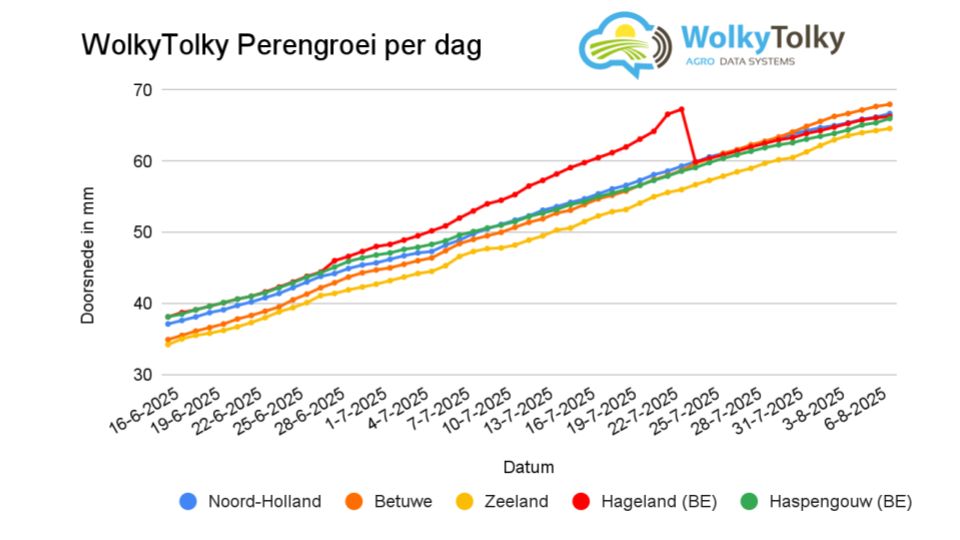
The Conference pears are larger than the long-term average in all regions. The most recent cross-sections per August 7 are:
- North Holland: 66.7 mm
- Betuwe: 68.0 mm
- Zeeland: 64.6 mm
- Haspengouw (BE): 66.3 mm
For comparison: the long-term average for Conference pears at harvest is between 60 and 70 mm. In some years, 70 mm is hardly reached; now we are well above that at the beginning of August.
Growth per week: figures from practice
The growth has remained remarkably constant over the past month. If we look at the data from July 8 to August 7, we see the following:
- North Holland: from 49.8 mm to 66.7 mm (+16.9 mm in 4 weeks, an average of 4.2 mm per week)
- Betuwe: from 49.8 mm to 68.0 mm (+18.2 mm in 4 weeks, an average of 4.6 mm per week)
- Zeeland: from 47.3 mm to 64.6 mm (+17.3 mm in 4 weeks, an average of 4.3 mm per week)
- Haspengouw: from 50.1 mm to 66.3 mm (+16.2 mm in 4 weeks, an average of 4.0 mm per week)
This growth rate is above average for this phase of the season. In a normal year, the growth in August is often around 2.5 to 3.5 mm per week.
Regional differences and trends
The Betuwe region is leading this year with the largest pears, followed by North Holland and Haspengouw. Zeeland is slightly behind, but growth is also strong there. The differences between the regions are smaller than in other years, which indicates a favorable and uniform growing season.
Harvest date: more than just fruit size
Although the fruit size is important for sorting and market value, the harvesting time of Conference pears is determined by several factors:
- Flesh firmness: A penetrometer is used to measure how firm the flesh is. Pears that are too hard are not yet ripe enough; pears that are too soft are less suitable for storage.
- Sugar content (Brix): The sugar content gives an indication of the ripeness. This is measured with a refractometer.
- Color of the seeds: Light brown seeds indicate harvest ripeness, dark brown seeds indicate eating ripeness.
- Skin color: The ground color changes from green to greenish-yellow at harvest ripeness.
- Detachment of the stem: A pear is ready for harvesting when the stem easily detaches from the branch.
- Degree days (temperature sum): The number of degree days after flowering gives an indication of the development of the fruit and is used for the first harvest forecasts.
The national indication for the harvest of Conference pears has been set at August 22 this year. However, this is an indicative date; the actual harvesting time may be a few days earlier or later, depending on the final ripening. The current advice from, for example, the VCBT and Dutch fruit growers’ organizations is therefore leading.
WolkyTolky: daily insight into growth
With the WolkyTolky dendrometers, the pears are automatically measured daily. This gives growers not only insight into the current growth, but also makes it possible to respond quickly to changes in the weather or irrigation. The data are directly available online and make it easy to compare your own situation with other regions. Want to know more about this technology? Visit www.wolkytolky.com.
Outlook: what can we expect at harvest?
With the current growth rate, it is plausible that the pears can reach an average of 70 to 75 mm or even more at harvest. That is above average and offers prospects for a good sorting for the growers. The expectation is that the growth will flatten out somewhat in the coming weeks, but the pears remain on track for a top year.
Conclusion
The Conference pears are growing exceptionally well this year. With two weeks to go until harvest, the fruits in all regions are already larger than average. The expectation is that the pears can reach a record size at harvest. Keep following our weekly updates for the latest figures and trends!
Would you like to know more about pear growth in your region or are you curious about the possibilities of automatic fruit measurement? Feel free to contact us or visit www.wolkytolky.com for more information!