In this article
Dendrometer data shows an interesting phenomenon – but also raises questions
The 2025 Conference harvest has started. Pears in the Netherlands and Belgium are being picked in full swing and are going into cold storage. Our dendrometer data, linked to WolkyTolky, shows a striking phenomenon: right after picking, we see a clear increase in the growth rate of the pears still on the tree.
📊 What we see in the data
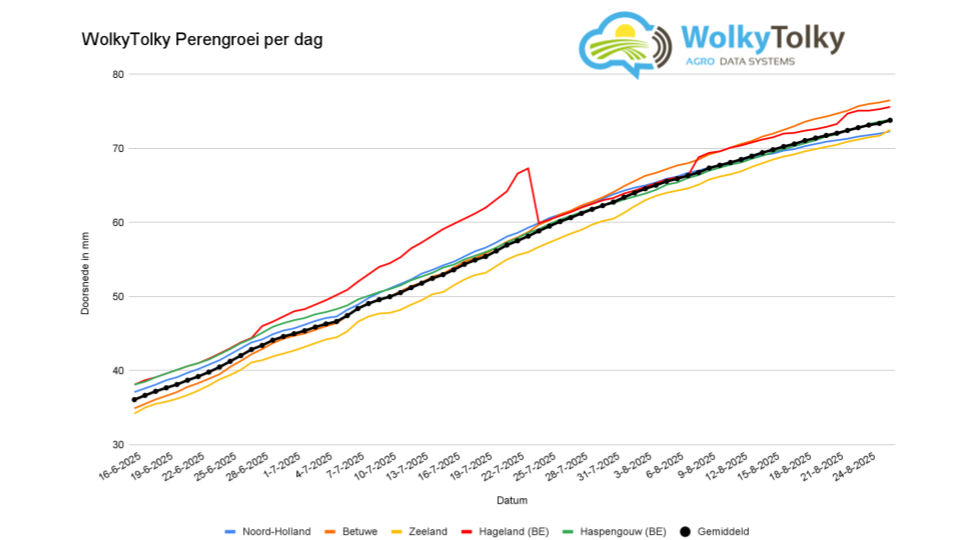
Our measurements with dendrometers in five fruit regions show:
- Before picking: normal growth of 0.28 mm a day
- Right after picking: growth rises to 0.44 mm a day (+57%)
This increase is consistently visible in our data from different regions. The explanation seems logical: fewer fruits on the tree means more energy available per remaining pear.
🔬 Practical example from Zeeland
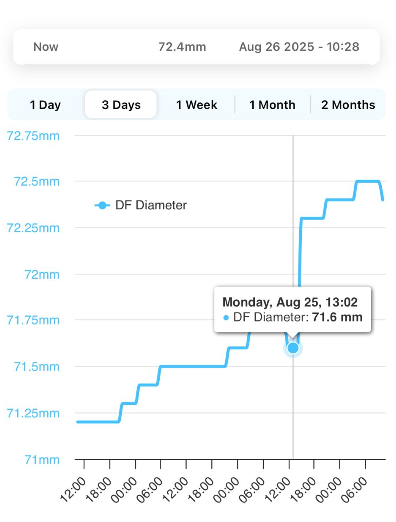
We saw a particularly clear example in Zeeland. On 25 August, almost all the pears were picked, except for one fruit with the dendrometer. Within 24 hours, this pear showed a growth spurt of almost 0.8 mm – much more than normal growth.
This extreme case (just one pear on the tree) illustrates the principle, but also raises questions about what happens in more realistic scenarios.
🤔 An interesting thought: staggered harvest
These observations lead to an intriguing question: could a staggered harvest strategy pay off?
The idea
- Week 1: pick 50% of the pears
- Week 3-4: pick the remaining 50% after an extra growing period
Possible benefits
- More growth for the second half thanks to reduced competition
- Potentially higher total yield per hectare
- Better size grade distribution
⚠️ Many uncertainties
Although the first results look promising, many questions remain unanswered:
- How much extra growth is realistic with a 50% pick (versus the extreme 1-pear scenario)?
- Quality effects: does quality stay good with a longer hanging time?
- Weather risks: what happens in bad weather?
- Practical feasibility: how do you organise this in terms of logistics and labour?
- Economic impact: do the extra costs outweigh the possible extra yield?
🔬 More research needed
These first observations are promising, but we are still at the beginning. Before we can recommend a staggered harvest as a serious strategy, more research is needed into:
- Growth patterns at different picking percentages
- Quality retention during an extended hanging time
- Economic feasibility in practice
- Risk factors and ways to mitigate them
🌐 The value of real-time data
What these observations do show is the value of continuous monitoring. By following growth live with WolkyTolky and dendrometers, you gain insight into processes that normally stay invisible. This opens doors to new insights and possibly better harvest strategies.
👉 Discover WolkyTolky and learn what happens in your orchard after picking
These observations are based on dendrometer data from North Holland, Betuwe, Zeeland, Hageland and Haspengouw. More research is needed to determine practical applicability.