In this article
Almost 5 millimetres difference in six days: what pear growth tells us this week
Almost five millimetres.
That is now the difference in fruit size between the fruit regions we follow. Half a centimetre may not sound like much at first. But in a pear, in the middle of the growing season, that difference tells a whole story.
Behind every millimetre are differences in soil, water availability, temperature, tree condition and crop load. And above all: differences you don’t always see when you walk through the orchard with a calliper once a week.
With more than twenty dendrometers in the field by now, we get a sharper picture of this every day. Most of the systems measure pears, spread across the Netherlands, Belgium, Germany, Poland and even Finland. Step by step, we are building an ever more complete picture of how fruit growth responds to conditions in practice.
The figures from 2 to 7 July
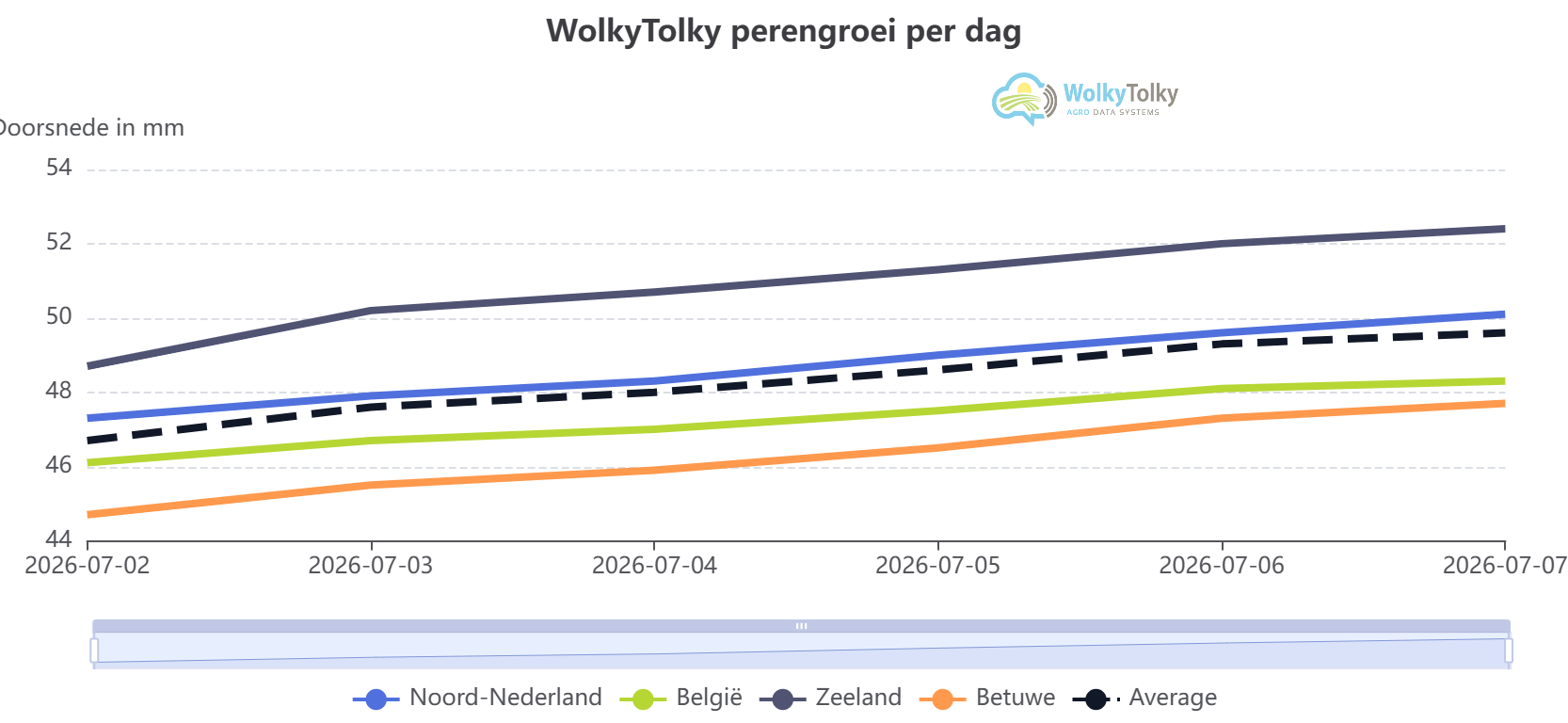
In the measuring period from 2 to 7 July, the average fruit size in the four fruit regions we follow rose from 46.7 to 49.6 millimetres. That is almost 3 millimetres of growth in six days.
But behind that average are clear regional differences:
-
Zeeland: from 48.7 to 52.4 mm — +3.7 mm
-
Betuwe: from 44.7 to 47.7 mm — +3.0 mm
-
Northern Netherlands: from 47.3 to 50.1 mm — +2.8 mm
-
Belgium: from 46.1 to 48.3 mm — +2.2 mm
Zeeland is clearly in the lead this week. Not only are the fruits there at a higher level, at 52.4 millimetres on average, but growth over the past few days was also the strongest.
At the other end of the overview we see Belgium. The pears kept growing there too, but at 2.2 millimetres the growth rate was clearly lower than in Zeeland. The difference between the largest and smallest average fruit size has therefore grown to almost half a centimetre.
Growth is not a given everywhere
Warm weather quickly gives the feeling that the pears “will grow anyway”. But the data shows that this assumption doesn’t always hold.
One orchard shows strong, fairly steady growth. Elsewhere the daily increase slows down, despite the same calendar date and seemingly similar weather. That is exactly why looking at temperature alone is not enough.
Fruit growth is influenced by a combination of factors:
-
Soil moisture: can the tree take up enough water when evaporation is high?
-
Temperature and radiation: do they stimulate growth, or does stress on the tree actually increase?
-
Crop load: does the tree have enough energy available for all the fruits?
-
Soil type and rooting: how well can the plot buffer and use moisture?
-
Tree condition: is the balance between leaf, fruit, water and assimilates still in order?
That is what makes pear growth so interesting. The fruit is not only the end product, but also a very sensitive indicator of what is happening in the tree at that moment.
The tree tells you what is happening right now
If you measure fruit weekly with a calliper, you get valuable information. But it remains mainly a snapshot. You see how much the fruit has grown since the previous round, but not when growth sped up, levelled off or temporarily stalled.
A dendrometer follows that movement continuously.
That way you see not only the result afterwards, but also the process as it happens. For example when a warm day leads to less growth, when an irrigation cycle seems to have an effect, or when a plot reacts noticeably differently from the region around it.
Especially in a period when the balance between heat and moisture can shift quickly, that difference matters. Don’t wait for the next measuring round, but see every day how the tree responds.
From single measurements to insight
With more than twenty dendrometers in five countries, we get something that goes beyond following growth on a single plot.
We see patterns. We see differences between regions. And we see that “the pears are growing well” is often a much more nuanced story than it looks at first sight.
For growers, the most important question is ultimately not just: how big are my pears today?
But above all:
Is my plot growing the way it should — and what can I do if it isn’t?
That is the strength of continuous measuring. Not hoping for the right size at the end of the season, but understanding earlier what the tree needs to get there.
We keep following the growth. From Finland to the Betuwe. Every day again.
#WolkyTolky #DataInsight #FruitGrowing #Pears #SmartFarming #Dendrometer